Businesses are constantly changing. Sometimes the use of technology leads, and other times it lags. To attain targeted business value from your use of technology, you need to recognize your current situation. At WIN, we developed the following framework to help organizations recognize the stage they are in and take appropriate actions to achieve targeted outcomes. We call this framework the Technology Lifecycle.
In this blog, we will share a few best practices that we have learned in partnering with our clients.
The Technology Lifecycle in Any Business
The technology applications you use are directly connected to attaining business value. Because the reliability, usability and security of those applications is reliant upon the underlying infrastructure, understanding the composition of those workloads and the impact on infrastructure is also an important consideration within the framework.
These shifts don’t happen all at once. They emerge as business priorities change, new tools are introduced, and external pressures reshape how work gets done. A few common scenarios illustrate how application decisions ripple through the rest of the environment.
Remote Workforce Transformation
Collaboration tools and remote applications
- An expanded cybersecurity threat surface must be addressed
- Requires increased compute, storage, bandwidth and resiliency
Application Architectures Differ
Operational system modernization
- ERP, SCM and IoT systems are adding features that change workload characteristics and impact infrastructure differently
- Movement of homegrown systems to new hosted environments requires assessments and changes
Introduction of SaaS
Sales and Marketing digital transformation
- Depreciation of replaced system critical for security and economics
- Backup and recovery for SaaS platforms often misunderstood or overlooked
- Maintaining security, productivity, and employee experience requires modifications to key infrastructure components such as two-factor authentication, single sign-on, and managed detection and response
Technology decisions compound over time. This is where the concept of a technology lifecycle becomes useful.
Stages of the Technology Lifecycle
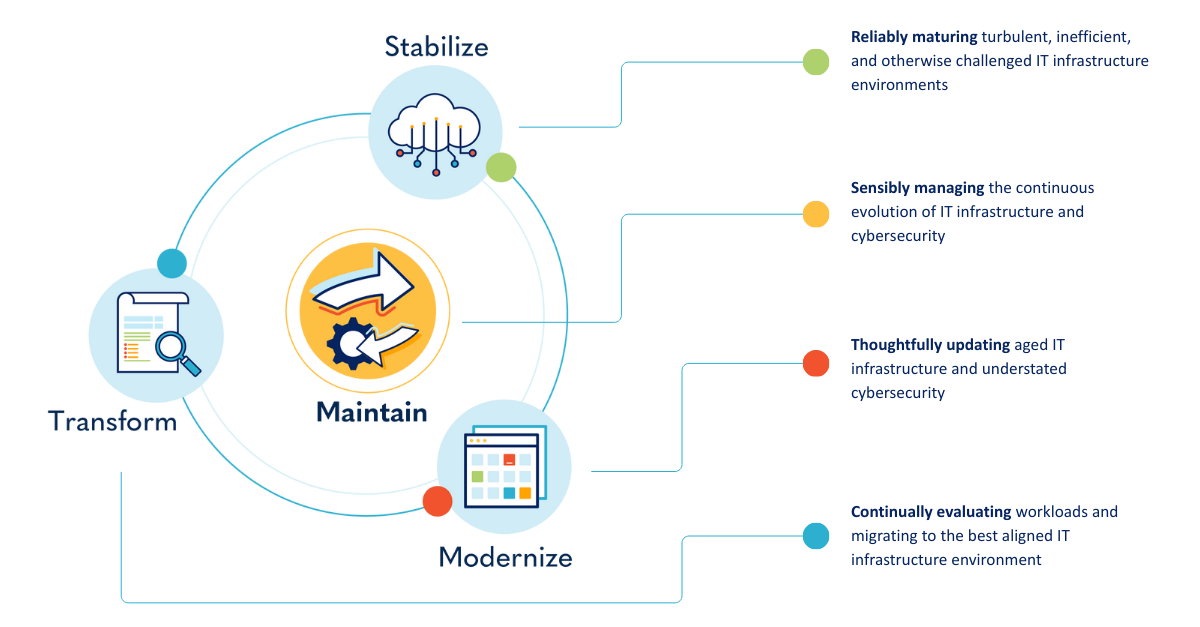
There are four technology lifecycle stages that all businesses experience: Maintain, Stabilize, Modernize and Transform. Often, organizations will experience two or three stages at a time. Each stage contains its own challenges and appropriate actions to achieve targeted outcomes. To help your organization effectively move through these stages, effective communication with your IT partner is essential.
Maintain
Sensibly managing the continuous evolution of IT infrastructure and cybersecurity
Technology is constantly progressing, and limited investment results in gaps in critical areas. The Maintain stage focuses on pragmatically adapting to change so you can hold your relative position.
What this Looks Like:
- Comfortable with current state processes and technology
- Comfortable with current cybersecurity stance
- No destabilizing business events expected
- Resources are optimized from a cost and use perspective
Desired Outcomes:
- Optimize costs
- Sustain prevailing risk position
- Harvest ROI from IT investments
Stabilize
Reliably maturing turbulent, inefficient, and otherwise challenged IT infrastructure environments and cybersecurity
All organizations face events that create disorder in their IT systems. The disorder is tolerable for some time and later surfaces as a substantial pain point. The Stabilize stage focuses on near term actions combined with longer-term planning to deliver your IT environment into a more orderly state.
What This Looks Like:
- Current state is chaotic
- Technology sprawl is a challenge
- Security is not where you want it
- Business is not receiving proper value from IT infrastructure investments
- Business events have created some level of disruption
- Line of Business applications not performing as needed
Desired Outcomes:
- Cost containment and predictability
- Improve risk position
- Increase productivity and employee experience
- Enrich customer experience
- Expand visibility of efforts and boost decision making confidence and pace
Modernize
Thoughtfully updating aged IT infrastructure and understated cybersecurity
The Modernize stage focuses on accelerating upgrades to infrastructure to extend beyond minimal maintenance of your relative state. Changing marketplace conditions drive the need to upgrade your infrastructure.
What This Looks Like:
- Current state is stable but deteriorating
- Technology scalability is a challenge
- Security is not utilizing modern tools or methods
- Business is not receiving proper value from IT infrastructure investments
- Business events have surfaced shortcomings of the current infrastructure stance
Desired Outcomes:
- Cost normalization
- Reduce risk
- Improve scalability to unlock growth, revenue, and profitability acceleration
- Accelerate productivity and employee experience
- Enrich customer experience
Transform
Continually evaluating workloads and migrating to the best aligned IT infrastructure environment and cybersecurity
Successful digital transformations occur over longer time windows and require a more holistic and intentional planning approach. The Transform stage focuses on planning, architecting, delivering, and supporting IT infrastructure geared to each phase of the digital transformation journey.
What This Looks Like:
- Current state is not optimized – business and supporting technology
- Technology support of digital transformation is a challenge
- Security paradigms are shifting with workload locations
- Business is embracing digital transformation and needs technology to enable it
- Business events are imposing the need for change within people, process, and technology
Desired Outcomes:
- Cost alignment
- Improve overall risk profile through expanded risk management paths and methods
- Accelerate productivity and employee experience
- Enrich customer experience
- Expand visibility of efforts and boost decision making confidence and pace
Communication: Thrive Through All Stages
Recognizing business value from technology usage is often elusive. One path to surfacing these values is brought about by continuous communication highlighting operational data in context. Regular communications with key contributors ensures awareness and drives action to designed to attain targeted business value.
A practical communication framework includes:
- Inform: Informative communication is delivered as the baseline data to convey what’s transpiring in your environment with your systems and our services.
- Guide: Guided communication adds benchmarks and other reference points to turn data into knowledge and insights to support your decisions.
- Activate: Activated communication extends insights into pragmatic planning and actions that produce value you can recognize and attain.
Why the Technology Lifecycle Matters
The technology lifecycle is not a linear path, nor is it something an organization completes once. It is a continuous balancing act shaped by business priorities, market conditions, and evolving risk. Understanding which stages your organization is operating in—and why—creates clarity around where to invest, where to stabilize, and where to plan for change. With the right communication and a clear view of the lifecycle, technology becomes less reactive and more intentional, enabling sustained business value over time.
Have Questions or Want to Learn More?
If you would like better understand how these lifecycle stages apply to your organization, read our eBook or talk to us!