
Your cybersecurity defenses should be like Swiss cheese. Not because you want holes — but because every tool, every control, and every safeguard you deploy has them.
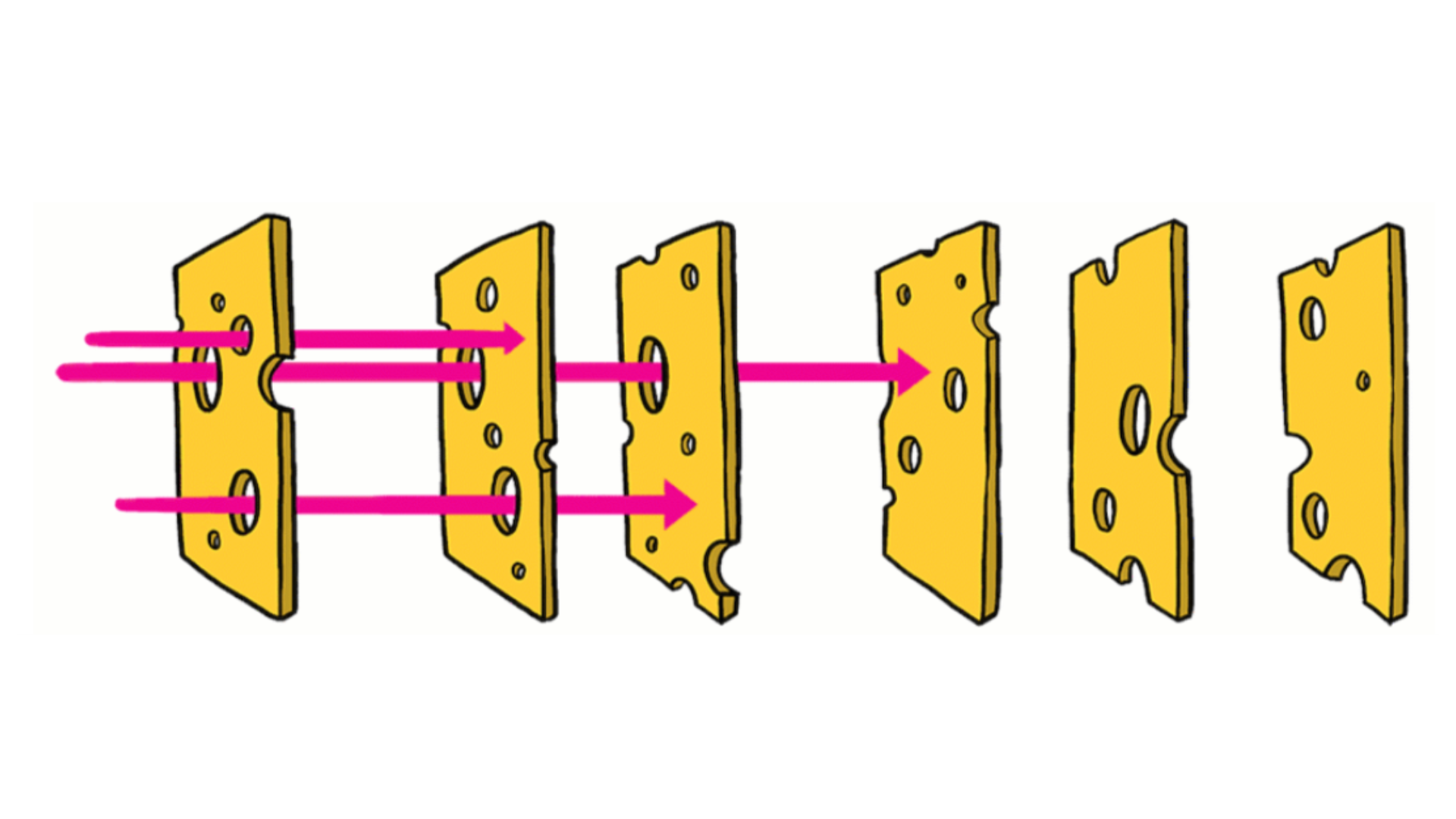
The question is not “is this defense perfect?” It’s “do I have enough layers that the holes never line up?”
What Is the Swiss Cheese Model?
The Swiss Cheese Model, developed by psychologist James Reason to explain why accidents occur. The premise: every safety layer has holes. A disaster only occurs when the holes in every layer align simultaneously, creating a clear path for a threat to travel all the way through.
Applied to cybersecurity, each control you implement — your firewall, your MFA, your email filter, your employee training — is a slice of cheese. Each slice has holes: misconfigurations, human errors, zero-days, blind spots. Stack enough slices, rotate them thoughtfully, and the holes stop aligning. Breaches stop getting through.
What Happens When the Holes Line Up: The KNP Logistics Story
In June 2023, KNP Logistics Group — a UK company operating for 158 years — permanently closed its doors after a ransomware attack carried out by the Akira group. The entry point wasn’t a sophisticated exploit. It was one guessed employee password with no MFA behind it.
Once inside, Akira moved fast. They encrypted operational systems, data, and — critically — the backups. Every lifeline, gone. The ransom demand was £5 million. KNP couldn’t pay. 700 people lost their jobs. A company that survived two world wars didn’t survive one weak password.
That’s the Swiss Cheese Model in its most devastating real-world form.

7 Reasons Layered Security Works
1. No Single Tool Stops Everything
Firewalls get misconfigured. MFA gets bypassed through fatigue bombing and SIM swapping. Antivirus misses zero-days by definition. EDR can be evaded by threat actors who study how it works. Every security control has gaps.
Understanding those limitations is what makes layered security effective. When multiple controls work together, the weaknesses in one layer are covered by the strengths in another, making a single mistake or missed detection far less likely to become a serious incident.
2. Layered Security Prioritizes the Highest-Impact Controls First
Effective layered security doesn’t require implementing every tool at once. In practice, a small number of well-implemented controls deliver the majority of risk reduction.
This follows a practical 80/20 rule: roughly 80% of common attack paths are blocked by about 20% of the right security controls — when those controls are implemented consistently and correctly.
For many organizations, the strongest early improvements come from:
- Multi-Factor Authentication (MFA) — closes one of the most common initial access vectors
- Password Management — eliminates weak and reused credentials across accounts
- Automated Patching — closes known vulnerabilities before attackers exploit them
- Security Awareness Training — makes users harder targets for phishing and social engineering
- Isolated, Tested Backups — provides a recovery layer when prevention fails
- Operating System Updates — keeps systems current and reduces exposure to known vulnerabilities
- Vulnerability Management — continuously identifies weaknesses before attackers discover them
Layered security maturity is built incrementally. The goal isn’t perfection on day one — it’s steadily reducing risk by improving coverage across multiple areas over time.
3. Frameworks Prevent Dangerous Security Gaps
One of the most common reasons security programs fail is imbalance. Organizations often overinvest in one area while neglecting others, creating gaps that weaken the overall strategy.
Security frameworks help solve this by turning cybersecurity into a structured system rather than a collection of disconnected tools.
Two widely used frameworks stand out:
The Essential Eight from the Australian Cyber Security Centre defines eight high-impact controls for reducing cyber incidents: application control, patching applications and operating systems, restricting macros, hardening user applications, restricting administrative privileges, MFA, and regular backups. Each represents a critical layer in a broader defense strategy.
The NIST Cybersecurity Framework (CSF) 2.0 from the National Institute of Standards and Technology organizes security into six functions: Govern, Identify, Protect, Detect, Respond, and Recover. The addition of “Govern” emphasizes that strong security depends on ownership, accountability, and consistent execution — not just technology.
Frameworks matter because layered security only works when all major areas are covered: prevention, detection, response, and recovery.
4. Identity Is the Layer Attackers Target First
Most modern ransomware and business email compromise attacks begin with compromised credentials. Phished passwords, stolen tokens, and weak authentication remain some of the most common ways attackers gain access to environments.
Strong identity protections create multiple barriers attackers must bypass before gaining access, including:
- Phishing-Resistant MFA — including hardware keys and passkeys for privileged accounts
- Conditional Access Policies — evaluates device health, location, and risk signals before granting access
- Privilege Management and Application Control — limits what users and applications can do if an account is compromised
5. Detection Makes Layered Security Resilient
Layered security recognizes that no preventive control is perfect. Detection and response layers help organizations identify suspicious activity quickly and limit the impact of an incident.
Getting past the perimeter is not automatically a major breach — response speed and visibility play a significant role in the outcome.
Key detection and response layers include:
- XDR (Extended Detection and Response) — correlates threat signals across endpoints, email, network, and cloud systems into a unified view
- Managed Detection and Response (MDR) — provides continuous monitoring and investigation outside normal business hours
- AI-Powered Email Filtering and Web Protection — blocks phishing attempts, malware, and malicious connections before users interact with them
The faster suspicious activity is identified, the more effectively organizations can contain and remediate potential threats.
6. Strong Layers Limit How Far Attackers Can Move
Most successful cyberattacks don’t rely on sophisticated zero-day exploits. Instead, attackers often gain access through a weak point and move laterally across poorly maintained or loosely segmented environments.
A layered security approach helps reduce these opportunities by creating barriers that limit how far an attacker can move within your network if a system is compromised.
An important containment measure is network segmentation, which isolates systems and restricts lateral movement between environments. This helps prevent a single breach from spreading across the organization and reduces the overall impact of an attack.
7. Recovery Layers Preserve Business Continuity
No defense is perfect. Organizations with strong recovery layers are better positioned to restore operations quickly and minimize disruption when incidents occur.
Layered security isn’t only about prevention — it’s also about ensuring the business can continue operating and recover efficiently when problems arise.
Recovery-focused layers include:
- Backup as a Service (BaaS) — isolated, immutable backups designed to remain protected from ransomware
- Disaster Recovery as a Service (DRaaS) — restores critical systems and operations after outages or cyber incidents
- Tested Recovery Processes — validates that backups, failover systems, and response procedures work as intended under real conditions
Resilient organizations plan for the possibility that individual controls may fail. Layered security works because it strengthens prevention, improves visibility, limits impact, and supports recovery across the entire environment.

Turning Layered Security into Action
Benjamin Franklin once said, “An ounce of prevention is worth a pound of cure.”
He was referring to fire safety in 1736. The same idea applies directly to cybersecurity today.
The goal is not perfect security; it’s building enough layers so that weaknesses don’t align in a way that creates meaningful risk. When controls work together, the overall system becomes far more resilient than any single tool on its own.
A practical place to start is the 80/20 rule: focus first on the small set of controls that deliver the majority of risk reduction. Frameworks like the Essential Eight and the NIST Cybersecurity Framework offer guidelines for prioritizing those efforts and building maturity over time.
You don’t need to navigate that process alone. At WIN Technology, we work with trusted partners across identity, endpoint protection, detection, recovery, and more to help organizations build layered security strategies that are both practical and scalable.
If you’re not sure where you stand today, our IT Maturity Assessment provides a clear, honest view of your current security posture along with a roadmap of what to address next.
And if you’re ready to take the next step, you can Talk to a WIN Specialist to explore what a layered cybersecurity strategy could look like for your organization.